
Top 7 Agility Ladder Drills for Quick Footwork in Soccer
Quick footwork is one of the most valuable skills in modern soccer. Whether you’re a winger trying to beat a defender, a midfielder pressing aggressively, or a defender reacting to sudden direction changes, agility and coordination can define your performance on the pitch. One of the most effective tools for developing these qualities is the agility ladder.
Agility ladder drills improve speed, coordination, balance, reaction time, and neuromuscular control all essential components of elite soccer performance. When performed correctly and consistently, ladder training helps players move more efficiently, reduce injury risk, and react faster during high pressure match situations.
In this article, we’ll break down the top 7 agility ladder drills for quick footwork in soccer, explain how to perform each drill, highlight common mistakes, and show how these drills translate directly to game situations.
Why Agility Ladder Training Matters in Soccer
Before jumping into the drills, it’s important to understand why agility ladder training works so well for soccer players.
Soccer is a game of constant movement. Players rarely sprint in a straight line for long distances. Instead, they perform:
- Short accelerations
- Rapid decelerations
- Lateral shuffles
- Quick cuts and turns
- Explosive changes of direction
Agility ladder drills help train:
- Foot speed how quickly your feet can move
- Coordination syncing foot movement with brain signals
- Balance & body control staying stable while moving fast
- Reaction time responding instantly to visual or verbal cues
When combined with ball work and match specific drills, agility ladders become a powerful tool for overall soccer development.
Drill 1: One Foot In (Single Step Run)
How to Perform
- Stand at the base of the ladder.
- Step into the first square with your right foot.
- Step into the next square with your left foot.
- Continue moving forward, placing one foot per square.
- Pump your arms naturally as you move.
Key Coaching Points
- Stay on the balls of your feet
- Keep your knees slightly bent
- Maintain a forward lean
- Look ahead, not down
Common Mistakes
- Slapping heels on the ground
- Over striding
- Losing rhythm and balance
Soccer Benefits
This drill builds a foundation for basic foot speed and running mechanics. It’s excellent for beginners and also serves as a warm up for advanced players. On the pitch, it improves sprint starts, recovery runs, and off ball movement.
Drill 2: Two Feet In (Quick Feet)
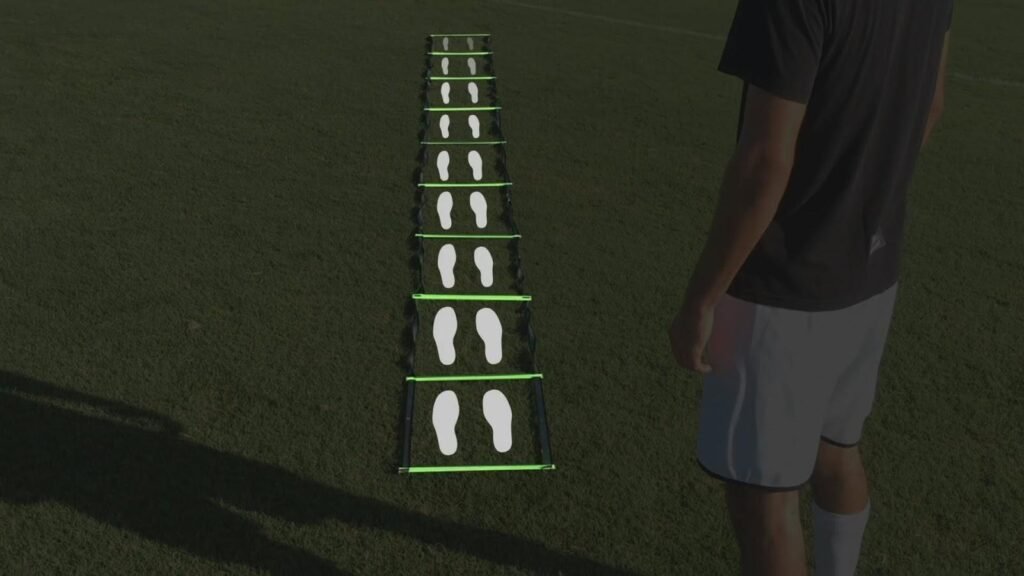

How to Perform
- Start at the first square.
- Step into the square with both feet (right then left).
- Immediately move to the next square.
- Maintain a fast but controlled rhythm.
Key Coaching Points
- Keep contact time with the ground as short as possible
- Use arms for balance and rhythm
- Maintain a steady tempo
Common Mistakes
- Jumping too high
- Landing flat footed
- Rushing and losing form
Soccer Benefits
This drill improves explosive foot speed and coordination. It directly translates to pressing, quick adjustments in tight spaces, and fast defensive reactions.
Drill 3: In In Out Out (Forward)

How to Perform
- Step into the first square with both feet (in in).
- Step outside the ladder to the right with both feet (out out).
- Move to the next square and repeat.
- Alternate sides after each repetition.
Key Coaching Points
- Keep hips low
- Stay light on your feet
- Maintain rhythm and symmetry
Common Mistakes
- Standing too upright
- Crossing feet
- Losing lateral balance
Soccer Benefits
This drill enhances lateral movement and quick transitions, which are essential for defenders tracking attackers and midfielders reacting to passing lanes.
Drill 4: Lateral High Knees

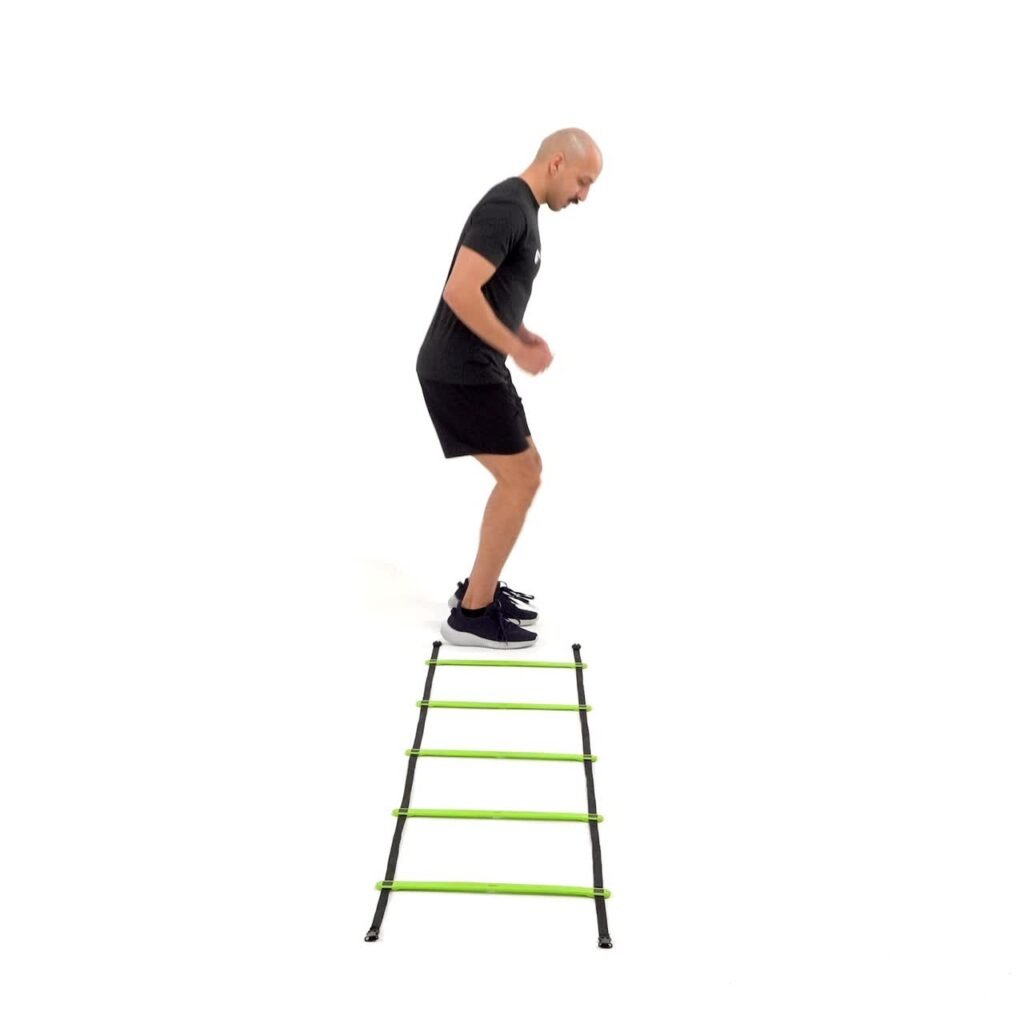
How to Perform
- Stand sideways next to the ladder.
- Step laterally into the first square.
- Lift knees high with each step.
- Move sideways through the ladder.
- Switch directions.
Key Coaching Points
- Drive knees up explosively
- Keep chest upright
- Maintain quick, light steps
Common Mistakes
- Shuffling instead of lifting knees
- Leaning too far forward
- Poor posture
Soccer Benefits
Lateral high knees improve hip mobility, coordination, and side to side explosiveness. This is critical for marking opponents, jockeying, and quick defensive adjustments.
Drill 5: Ickey Shuffle


How to Perform
- Stand sideways to the ladder.
- Step inside the square with the lead foot.
- Step inside with the trailing foot.
- Step outside the ladder.
- Move forward and repeat.
Key Coaching Points
- Keep movements smooth and controlled
- Maintain rhythm over speed initially
- Stay low and balanced
Common Mistakes
- Over speeding and losing coordination
- Crossing feet incorrectly
- Standing too tall
Soccer Benefits
The Ickey Shuffle is excellent for coordination, agility, and change of direction. It closely mimics movements used when dribbling past defenders or adjusting body position to receive the ball.
Drill 6: Carioca (Grapevine)

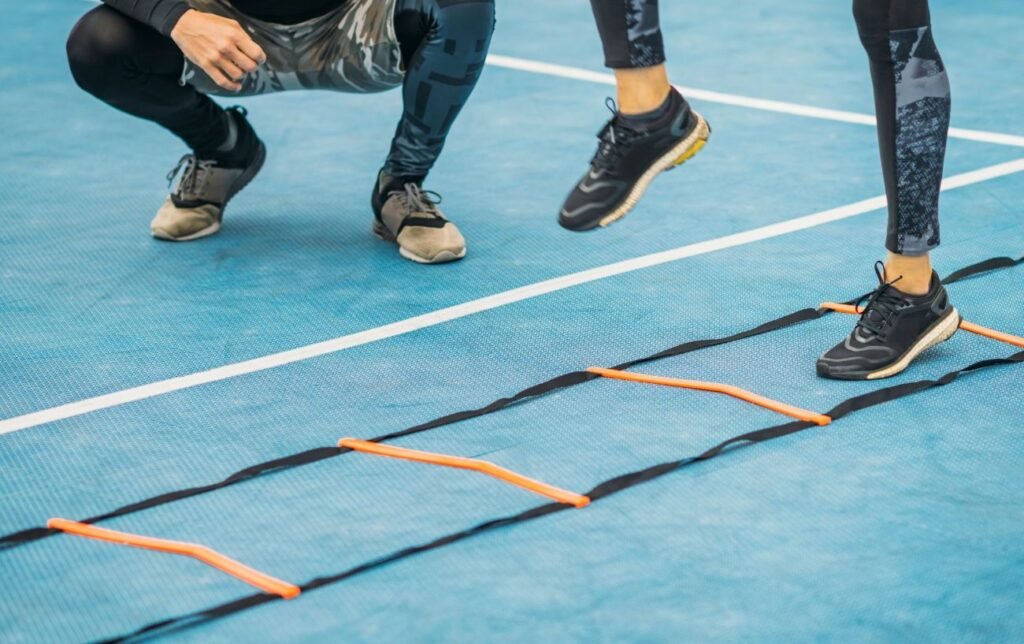
How to Perform
- Stand sideways at the ladder.
- Cross the back foot behind the lead foot into the square.
- Step out with the lead foot.
- Alternate crossing in front and behind.
- Switch directions.
Key Coaching Points
- Rotate hips naturally
- Keep upper body relaxed
- Focus on fluid movement
Common Mistakes
- Stiff hips
- Poor foot placement
- Rushing the movement
Soccer Benefits
Carioca drills improve hip rotation, coordination, and lateral agility crucial for turning, shielding the ball, and defensive recovery movements.
Drill 7: Reaction Ladder Drill

How to Perform
- Perform any basic ladder drill.
- Have a coach or partner call out commands (left, right, sprint, stop).
- React instantly while maintaining footwork pattern.
- Add a ball pass or sprint at the end.
Key Coaching Points
- React without hesitation
- Keep eyes up
- Stay mentally engaged
Common Mistakes
- Delayed reactions
- Losing footwork rhythm
- Watching feet instead of surroundings
Soccer Benefits
Reaction ladder drills train decision making under pressure, making them highly game realistic. They improve awareness, anticipation, and mental sharpness.
How to Structure Agility Ladder Training
For best results:
- Perform ladder drills 2–4 times per week
- Keep sessions short (10–20 minutes)
- Focus on quality over speed
- Combine ladder drills with:
- Ball control exercises
- Sprint training
- Small sided games
- Ball control exercises
Sample Ladder Session (15 Minutes)
- Warm up jog & mobility 5 min
- 3 ladder drills (2 sets each) 8 min
- Reaction drill finisher 2 min
Final Thoughts
Agility ladder drills are not just warm up exercises they are a powerful tool for building elite footwork, coordination, and game speed reactions in soccer players of all levels. The seven drills outlined above cover forward, lateral, rotational, and reactive movements that directly translate to match performance.
Remember, agility isn’t just about moving fast it’s about moving efficiently, intelligently, and under control. When combined with proper technique, consistency, and soccer specific training, agility ladder drills can give you a real competitive edge on the pitch.